Mosiuoa Lekota, Anti-Apartheid Stalwart and Former South African Defence Minister, Passes Away at 77
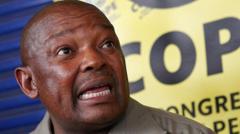
Mosiuoa Lekota, a prominent figure in South Africa's anti-apartheid movement and former defence minister, has died at the age of 77 after a period of illness. Lekota was a key player in the struggle against apartheid, having been imprisoned on Robben Island alongside Nelson Mandela. He later became the chairperson of the African National Congress (ANC) before founding a rival political party, the Congress of the People (Cope), in response to corruption allegations within the ANC.
President Cyril Ramaphosa paid tribute to Lekota, describing him as a "freedom fighter and a servant of the people" whose life was marked by resilience and a steadfast belief in justice. Lekota was one of South Africa's longest-serving ministers, holding the position of defence minister from 1998 to 2008. He also served as the first premier of the Free State province after the country's transition to democracy in 1994.
Lekota, affectionately nicknamed "Terror" for his football skills, left the ANC in 2008 following the removal of former President Thabo Mbeki. Disillusioned with the ANC's governance and corruption allegations, he co-founded Cope with Mbhazima Shilowa, another former ANC leader. Cope initially performed well in the 2009 general elections, securing 30 seats in parliament, but its influence waned over the years due to internal leadership conflicts. By the 2024 elections, Cope failed to win any parliamentary seats.
Lekota's political journey began as an anti-apartheid activist. He was first imprisoned in 1974 under the Terrorism Act and spent years on Robben Island. After his release, he was again arrested in connection with his leadership role in the United Democratic Front (UDF), a coalition fighting racial segregation. He was charged with treason in the Delmas Treason Trial but was later acquitted by the Supreme Court of Appeal.
Trevor Manuel, a friend and former UDF leader, praised Lekota as an "amazing human being" deeply committed to South Africa. Manuel recounted Lekota's unwavering dedication to the anti-apartheid cause and his impact on those around him. He last visited Lekota in intensive care two weeks before his passing, noting the "brave and long battle" Lekota fought against his illness.
Lekota's legacy is marked by his contributions to South Africa's political landscape, both as a staunch opponent of apartheid and as a leader who sought to address corruption within the ruling party. His death marks the end of a significant chapter in the country's history, reflecting the enduring struggle for justice and equality.